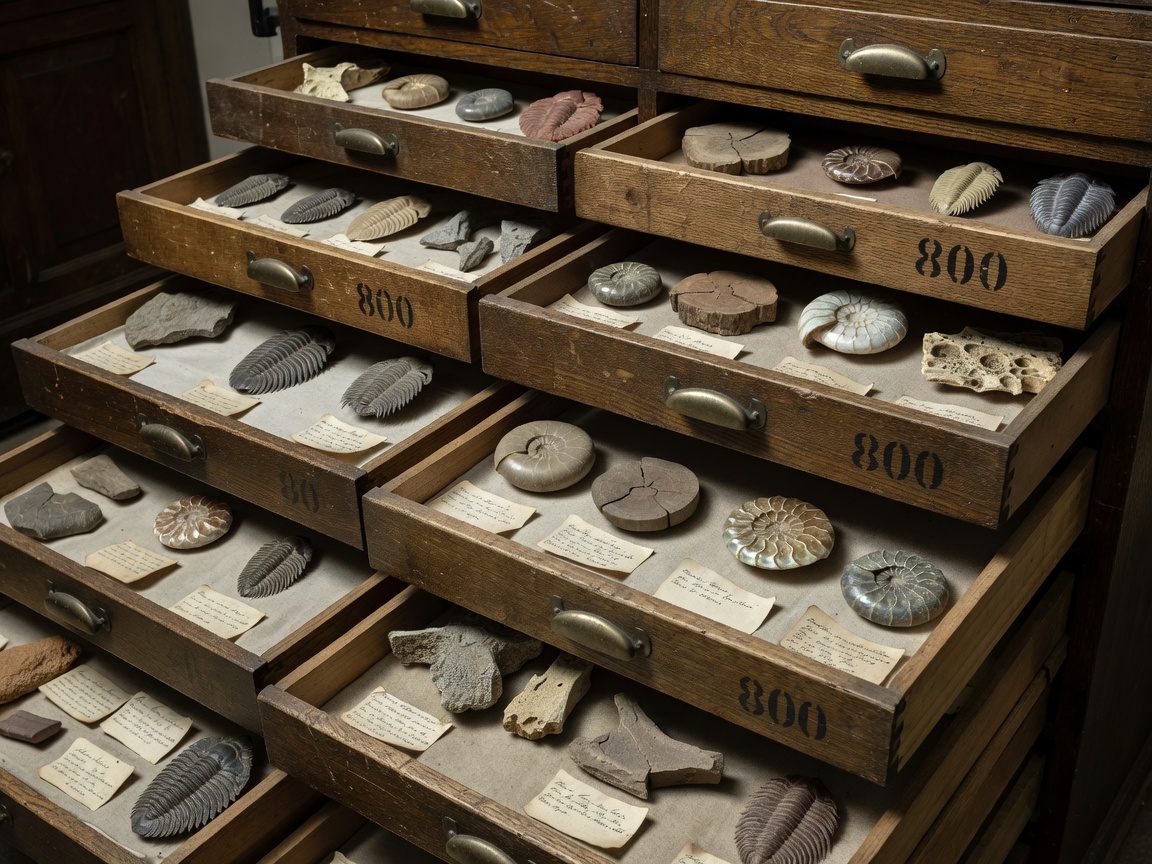
Museums, universities and regional institutions care for fossils for different purposes. Public display is only one part of collection work. Storage, documentation, conservation and research access can be equally important, even when the specimens are not on view.
Four collection types
Public exhibition collections are selected and interpreted for visitors. Displays often emphasize recognizable forms, geological stories or local heritage. Labels provide a starting point, but a display may simplify complex evidence to fit its space. Check current visitor information through the institution itself; this guide does not list verified hours, admission details or temporary exhibitions.
Research collections hold material used for study and comparison. Access is usually arranged through a formal request and may depend on staff capacity, conservation needs, legal status and research purpose. Some specimens are too fragile, restricted or valuable to handle. A database record does not mean a specimen is available for immediate viewing.
Teaching collections support instruction. They may contain examples selected to demonstrate structures, preservation or geological concepts. A teaching set can be handled under supervision, but the institution’s rules remain in force. Materials may be replicas or teaching casts rather than original fossils, so read labels carefully.
Reference collections provide documented material for comparison. Their value depends on reliable identification, locality information and a stable record of changes to that identification. A reference specimen is not necessarily on public display, and specialist access is normally controlled.
Catalogues carry context
A useful collection record links an object to its identifier, taxonomic assessment, locality, geological unit, acquisition history and any conservation notes available to the institution. Cataloguing is the process of recording and maintaining this information. Fields vary between organizations. Older entries may use historical place names or classifications that need interpretation.
Collection databases can help locate records, but online descriptions are not always complete or current. A search result may refer to a lot containing several pieces, a cast, a photograph or an object whose precise locality is restricted. Read the record’s scope and contact the holding organization for authoritative clarification. Do not invent or repeat specimen numbers when discussing an object without a verified source.
Behind the display case
Preparation laboratories remove surrounding rock or stabilize specimens using methods chosen for a particular material. This work can require trained staff, documentation and specialist equipment. Preparation changes an object’s appearance and can expose structures, but it may also remove evidence if performed without a conservation plan. Visitors should not treat a lab demonstration as a do-it-yourself procedure.
Storage conditions are tailored to object type. Fossils may be brittle, fractured, mineralized or attached to unstable matrix. Staff use supports, trays, labels and controlled handling practices to reduce risk. A specimen’s physical care and its documentation are connected: losing the label can remove the locality information that makes the item scientifically useful.
Plan a collection visit or enquiry
- Check the institution’s official visitor information before travelling.
- Distinguish public galleries from collection stores and research facilities.
- For research access, describe the subject, material needed and intended dates in a concise request.
- Ask whether photography, notes or handling are permitted. Do not assume either is allowed.
- Use the collection’s own record as the authority for object details and citation requirements.
How to assess a collection record
Look for a clear institutional source, a description of what the record represents and a link between specimen, locality and geological context. Check whether an identification is presented as current or historical. When details are absent, record that limitation rather than filling gaps with assumptions. If a database offers a citation format, follow it.
Good for
Comparing specimens without disturbing field material, learning how scientific cataloguing works, and seeing how museums translate geological evidence for different audiences.
What to know
Public access, research access and collection use are separate permissions. Contact the institution for current arrangements and never imply that an online record confirms access.
Exhibitions and digital records complement each other
A gallery offers scale, orientation and interpretation. A catalogue may provide more precise object data. Neither replaces the other. Read display text as an introduction, then consult institutional records for detail. For a visit plan, compare gallery themes with your research question and allow time to record source information accurately.